What Riders Told Us: Recent Survey Highlights
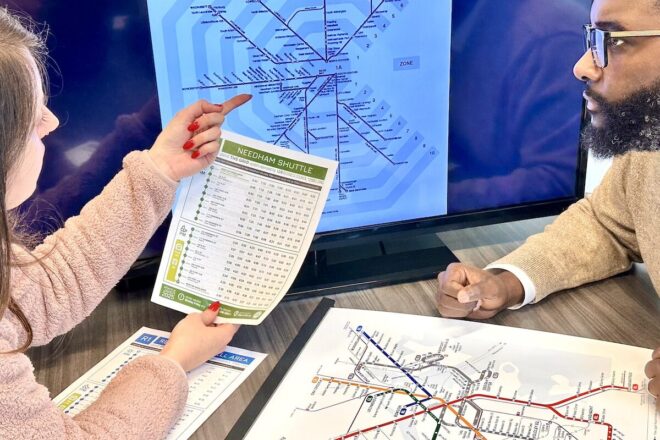
The Grid connects thousands of commuters to workplaces that can be difficult to reach by regional transit alone. This summer, we asked riders on two very different Grid routes (the W1 and N1) how those connections affect the way they travel.
Two Routes with Different Stories
The W1: Waltham Shuttle is one of The Grid’s oldest routes. It connects Waltham Center with the Winter Street/Second Avenue employment area in northwest Waltham. The route currently offers four weekday departures in each direction during the morning and evening commute periods.
The N1: Needham Shuttle is much newer and is one of our fastest-growing routes. Keeping up with its expanding ridership has created a happy challenge for our Operations Department. The N1 links Newton Highlands and the Green Line with the Needham Crossing area, with eight weekday departures during each commute period.
Why We Surveyed Riders
We surveyed W1 and N1 riders as part of grant-related work supporting these services.
In 2025, MassDOT awarded 128 Business Council more than $360,000 through its TMA Grant Program. The funding supported continuing with expanded N1 service, service-level preservation of the W1, rider outreach, and efforts to strengthen long-term private-sector support for both routes.
That work built on the grant program’s inaugural 2024 grant round. Among other investments, that funding supported the N1’s expansion from four to eight morning and evening departures. That year’s grant funding also supported the REV Bus system and a major website overhaul.
What We Asked
The surveys were deliberately short. In fact, we only asked five questions:
- How do you connect with the shuttle? N1 riders overwhelmingly (90.3%) connect through the Green Line. W1 riders reported a wider mix of MBTA bus, walking, Commuter Rail, biking, and getting a ride.
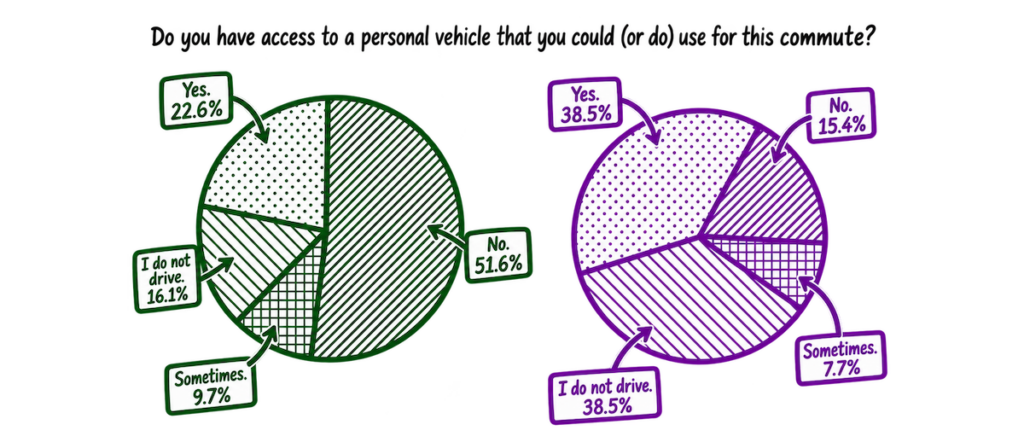
- Do you have access to a personal vehicle that you could use for this commute? More than half (51.6%) of N1 respondents had no vehicle available, while another 9.7% reported only partial access and 16.1% do not drive at all. The results were not quite as dramatic on the W1, but still amounted to more than half of respondents having little-to-no access to personal vehicles.
- About how many weekly shuttle trips would otherwise be made entirely by car? The vast majority of riders on both routes reported replacing at least some would-have-been-car trips with shuttle trips.
- How did recent service increases affect your riding habits? The W1 question focused on its 2025 increase from three to four departures. The N1 question asked about its 2024 increase from four to eight. On the W1, 61.5% of riders reported riding more often post-service increase. On the N1, 16.1% of respondents said they ride more often since service doubled, while another 12.9% said they began riding partially or entirely because of the schedule improvement. Another 32.3% began riding after November 2024 for reasons unrelated to the service increase. This makes sense in context: the N1 expansion responded to already-growing (not anticipated) demand, and ridership has continued to build since then.
- How would your life change if the shuttle were no longer available? Responses ranged from driving a personal vehicle or using rideshare instead to working from home more, changing roles, or even leaving a current job.
Here Are the Major Takeaways
When service improves, riders notice. As mentioned above, after the W1 increased from three to four morning and evening departures, 61.5% of respondents said they began riding more often.
Shuttle access is an essential employee retention tool. Among N1 respondents, 41.9% said they would consider looking for another job without the shuttle, while 25.8% said they would need to leave their current job.
Shuttle access also drives (or prevents) employee recruiting. Again, 51.6% of N1 respondents did not have access to a personal vehicle for their commute; 9.7% only have access “on certain days or when it is not being used by someone else”; and another 16.1% do not drive at all.
On the W1, 15.4% reported not having access to a personal vehicle for their commute; 7.7% reported having partial access; and a full 38.5% reported not driving at all. That amounts to 61.6% of that survey pool.
The Grid helps close the gap between regional transit and suburban workplaces. More than 90% of N1 respondents reach the shuttle via the MBTA Green Line. W1 riders used a more varied mix, but MBTA use is heavy: 38.5% connect by MBTA bus and 30.8% arrive by Commuter Rail. (Respondents could select more than one mode.)
More shuttle riders mean fewer cars on the road. Every W1 respondent reported that at least one weekly shuttle trip would otherwise be made entirely by car; 84.6% said five or more trips would. On the N1, 87.1% reported replacing at least one weekly car trip, and 45.2% said nine or ten of their weekly shuttle trips would otherwise be made entirely by car.
Of course, these surveys represent only a snapshot of the Grid’s full ridership. Even so, the results show how much a relatively short “last-mile” connection can accomplish. Better shuttle service expands individuals’ access to jobs. It expands companies’ access to potential employees. It strengthens connections to the MBTA. And it keeps a substantial number of would-be car trips off already-congested regional roads.