Thriving Region, Stalled Highways
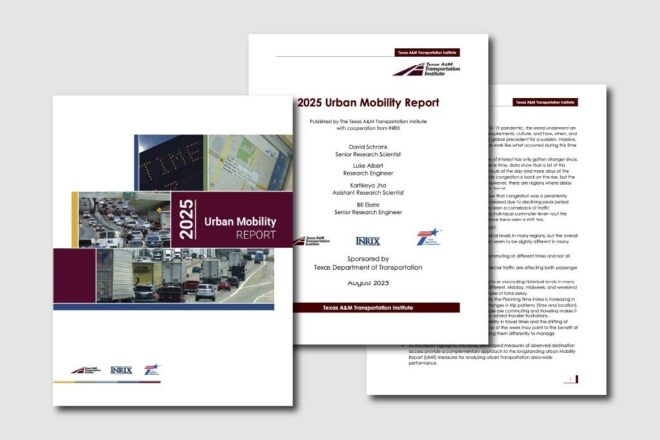
As traffic on Route 128 and across Greater Boston reminds us daily, congestion hasn’t just “come back.” It has blown past old records. According to the Texas A&M Transportation Institute’s 2025 Urban Mobility Report, drivers in 2024 lost an average of 63 hours per person sitting in traffic—almost eight full workdays behind the wheel.
“Delays are no longer confined to the traditional weekday rush hours; instead, they’re spreading to midday, midweek and even weekends.”
–Texas A&M Transportation Institute’s 2025 Urban Mobility Report press release
What used to be a predictable morning and evening crunch has crept across more hours of the day and more days of the week. Hybrid work schedules, e-commerce deliveries, and new patterns of leisure trips all play a role in shifting when people are on the road.
For our riders and member companies, that creeping congestion shows up as longer, less predictable drive-alone trips, more stress around getting to and from work on time, and more pressure on companies trying to bring people back into the office. It’s no longer enough to plan around a single peak hour. Commuting has become an all-day challenge.
Thriving Region, Terrible Traffic: Two Sides of the Same Coin?
Texas A&M’s Urban Mobility Report makes another key point: congestion hits hardest in places where the economy is humming. Over several decades of tracking trends, the report has documented how roadway congestion has become a persistent challenge, especially in regions with strong economies and steady population growth.
As lead author David Schrank notes, “Congestion is a fact of life in thriving regions.” That certainly describes the Greater Boston area and the Route 128 West corridor, where job growth, new developments, and major institutions all pull people onto the same set of roads.
But Schrank may be too quick to accept the inevitability of the economy-congestion connection. No one is going to celebrate clogged highways as an indicator of a strong economy. No region should become complacent just because traffic can be a by-product of success. The real question is whether regions like ours will choose to live with longer and longer delays every year, or whether we will get smarter about our travel options.
Congestion is Personal
For individual commuters, all of this is happening in the middle of a cost-of-living crisis. Fast Company, summarizing new data from Owl Labs’ 2025 State of Hybrid Work report, notes that going into the office now costs workers about $55 per day on average. Working from home averages about $18 per day, so hybrid workers save around $37 on days they stay home.
Fast Company also reports that 17% of workers surveyed said they had quit in the past year because of changes to their working arrangements, including return-to-office requirements. But 92% said the right incentives could convince them to return to the office. Those numbers make clear that the commute is not just an inconvenience. It’s an economic pain point that shapes real career decisions.
Rising prices for gas, parking, and even a simple lunch magnify the emotional weight of every slow mile in traffic. When the cost of simply showing up keeps climbing, it’s no surprise that people start looking for flexibility, better support, or both.
Why Congestion Should Worry Employers and Developers
Those same costs quickly turn into a challenge for employers. For companies trying to bring people back even a few days a week, the commute is now a core part of the value proposition. If the trip feels expensive, time-consuming, and unpredictable, return-to-office policies will always face resistance—and some employees will simply leave. On the other hand, organizations that reduce commute stress and cost can stand out in a competitive talent market.
That means developers also have a lot at stake here. Office and lab space is only as valuable as its effective access. Buildings surrounded by traffic and limited to drive-alone trips will be harder to lease and less resilient over time. Projects that integrate strong multimodal access are better positioned to attract employers who want to offer their teams a commute that works.
What do we mean by “strong multimodal access”? Transit connections, safe walking and biking routes, incentives for carpooling, and, of course, shuttles.
If It’s Only About Roads, It Won’t Work
The Urban Mobility Report is clear on one thing: no single solution can fix congestion. The full report states: “More and expanded roadways, better public transportation, efficient traffic operations, more travel options, new land development styles, and advanced technologies need to be deployed.”
That list starts with road capacity, but it doesn’t end there—and neither should we. In fact, decades of research on “induced demand” suggest we should be skeptical about the claim that road widening can provide lasting relief. Studies typically find that most new road capacity fills with additional vehicle travel within a few years, bringing congestion back toward pre-expansion levels.
Regions that treat congestion as a roadway-only problem will struggle. Regions that manage growth with multimodal strategies have a much better chance of keeping people and economies moving.
The Grid Already Puts This Data into Action
The Grid is exactly one of these on-the-ground solutions. Our cooperative shuttle network links MBTA stations, park-and-ride locations, and major employment centers across the Route 128 West Corridor, giving commuters a reliable alternative to driving alone.
For riders, The Grid turns a stressful, stop-and-go drive into a predictable trip where they can read, answer emails, or simply decompress. For employers and developers, participation in The Grid demonstrates a concrete commitment to sustainable access, helps support return-to-office goals, and strengthens their position in a tight labor market. And for the region as a whole, every worker who shifts from a solo car trip to a shuttle or transit-plus-shuttle commute helps reduce congestion, emissions, and parking pressure.
In other words, The Grid is exactly the kind of multimodal strategy the Urban Mobility Report calls for—built right here, for the communities and companies that rely on the Route 128 West Corridor every day.