When There’s No App for That: Planning Shared Transportation Without an Algorithm

Now in its fourth decade, 128 Business Council serves corporate, residential, institutional, and municipal members along Route 128 West. Our largest activity is managing The Grid, a cooperative shuttle network uniting 31 funding members across 10 fixed routes and 53 stops.
128 Business Council was formed in 1987 following a transportation impact study of the Route 128 West Corridor. That study concluded that rising congestion would harm the region if traffic-reducing measures were not implemented. We were the first Transportation Management Association (TMA) in the Commonwealth of Massachusetts.
As the field has evolved, our core question has stayed the same: what actually reduces peak-period driving demand in a congested suburban employment corridor? Over decades, we’ve learned that the most durable models rely on cooperation and consistency, not novelty. That institutional memory informs how we plan The Grid today.
What makes The Grid work
By sustaining reliable peak-period shared service, The Grid provides access to jobs, strengthens employer recruitment and retention, and reduces single-occupancy vehicle demand in the Greater Boston area. Behind the scenes, we rely on “old-school” tools: endless Excel schedules and equally endless conversations—slow, meticulous human planning work.
That spreadsheet-based work is extremely granular. It includes minute-by-minute accounting for each stop, each vehicle transition, and each driver break, plus ongoing stop-level and system-level ridership analysis. We also make iterative timetable tweaks throughout the year to respond to changing conditions.
That said, we aren’t anti-technology. We were flagship adopters of the Tripshot app’s contactless payment capabilities, and we routinely use tech-derived data—like mobile ticketing activity and on-time performance reports—to inform planning decisions. But that technology supports the cooperative system we’ve built. It doesn’t build that cooperation for us.
The Outcomes That Matter
The outcomes show what this planning delivers. In 2025, The Grid’s two largest route systems exceeded pre-pandemic ridership. The N1: Needham Shuttle provided 25.4K rides (121% of 2019), and the Alewife Shuttle System delivered 113K rides (102% of 2019) using fewer buses and fewer service hours than in 2019.
This is particularly notable because many fixed-route systems have rebounded primarily through off-peak and weekend travel by occasional riders, while The Grid’s recovery is driven entirely by peak-period commuters.
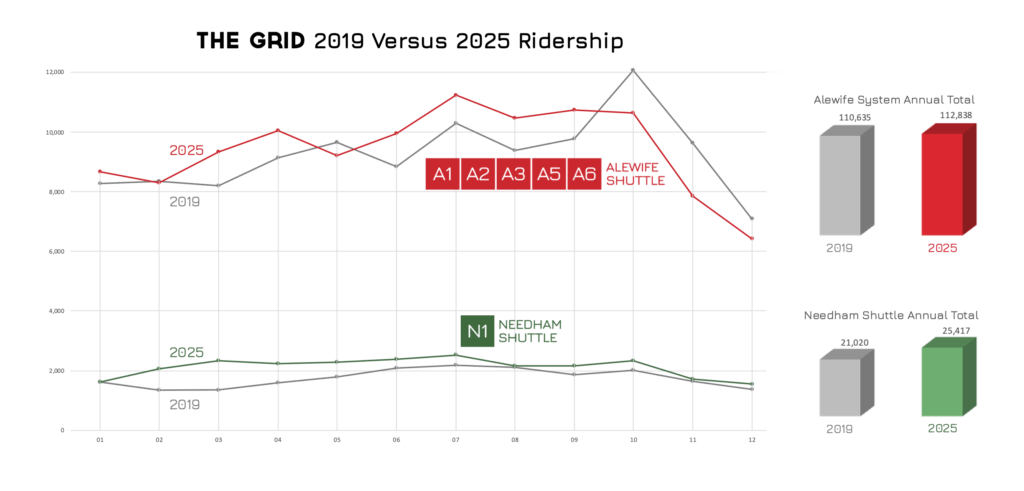
The Grid’s success is rooted in our planning approach—not algorithms, but spreadsheets and dialogue.
The Overlap Problem
Over the last decade, there’s been a growing wave of app-based attempts to create pooled transportation with flexible routing and individualized pickup patterns. The promise is compelling: real-time adjustments, optimized pooling, and more rider choice in time and location. But many of these approaches still run into basic constraints of math and human behavior. For high-volume commuter service, those constraints matter. When riders can leave from any address at any time, overlapping trips are rare.
The Grid’s fixed routes don’t just move vehicles; they shape behavior. Shared hubs and common departure times sharply increase overlaps and shared rides. The Grid’s hubs—Alewife Station, Waltham Center, and Newton Highlands—already function as regional anchors. They concentrate demand and simplify wayfinding, which supports dependable schedules. They also make it easier for commuters from different organizations to share the same vehicles.
Of course, algorithm-based, often door-to-door services have real value in specific contexts. Late-night service, very low-density areas, and paratransit or paratransit-adjacent needs can all benefit from more individualized trip patterns. In those settings, the goal is often basic coverage and access rather than high-capacity pooling. The Grid’s focus, by contrast, is maximizing shared rides during peak commute windows.
Cooperation is the Key
The Grid maximizes shared rides through two essential layers of social cooperation: riders and funding partners. Riders accept a modest loss of flexibility—meeting at shared hubs and choosing among scheduled departure times—in exchange for service that is more reliable and frequent.
Member companies, in turn, commit to cooperative routing and financing. It’s understandable that employers or property owners may initially request a branded, exclusive shuttle they can market as a private amenity. But exclusivity fragments demand and leads to duplicative vehicles running similar trips. The Grid asks its funding partners to reframe shuttle access as a communal good that is shared across organizations. In return, our members can support more frequent, higher-quality service than they could afford alone.
These two layers of cooperation—riders and members—reinforce each other.
The Grid’s lesson is simple: human planning and cooperation build a successful system that advances regional transportation demand management goals and offers a replicable model for planning high-impact, cooperative fixed-route service.