Congestion Pricing in the Commonwealth: Lessons from NYC’s First Year
Streetsblog Massachusetts reported back in December that lawmakers are openly naming congestion pricing as a policy worth discussing—especially as the state searches for stable, scalable revenue.
Congestion pricing is a fee mechanism that charges vehicles entering a defined area, typically at peak periods. It’s a possible finding source that sits at the intersection of multiple goals: reducing congestion, improving reliability, and generating revenue that can be reinvested in other transportation options.
It also tends to provoke immediate, visceral reactions—often before the public has a chance to review real-world outcomes. Yet, Senator Brendan Crighton (co-chair of the legislature’s Joint Committee on Transportation) says emphatically, “We shouldn’t be scared to have these conversations.”
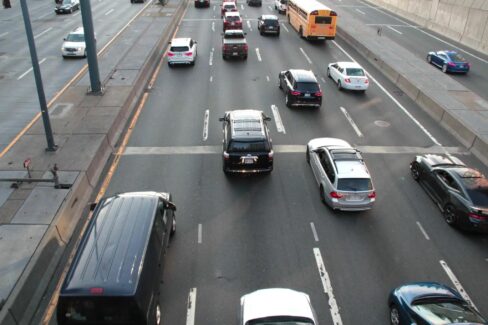
Fast Company’s look back at NYC’s first year presents a clear headline: “It’s been one full year of congestion pricing in New York City, and downtown Manhattan looks markedly different: 23.7 million fewer vehicles, traffic delays down 25%, and a 22% drop in air pollution, to start.”
Those numbers capture exactly why congestion pricing is so compelling. It can raise funds while also changing behavior. As one supporter summarized the first-year results, the policy has been “overwhelmingly successful.”
NYC’s experience also underscores that congestion pricing isn’t only about traffic flow. Fewer vehicles in a core zone mean more available roadway for other modes, more reliable transit trips, and a cleaner, safer environment. It’s about what happens when street space is treated as a scarce communal resource—something that should be managed for the benefit of all, rather than endlessly expanded for a single mode.
If Massachusetts were to seriously consider congestion pricing, we would need to think clearly about how regional conditions could shape outcomes. And there are a number of key differences between Boston and NYC that could matter a lot.
First, Greater Boston’s job geography is less centralized. NYC benefits from an extremely dense Central Business District with a uniquely concentrated “below 60th” core. Downtown Boston is a major center, but it shares the stage with Kendall Square, the Longwood Medical Area, the Seaport, and a network of employment nodes along Route 128 that are neither urban nor truly suburban.

That means a Manhattan-style “single core zone” might reduce congestion in one place while leaving other chokepoints largely unchanged. It could also shift traffic congestion to other major employment centers.
Second, transit looks very different here than in NYC. New York’s subway network provides a level of frequency, redundancy, and grid-based geographic coverage that Greater Boston’s history and geography thwart.
In Massachusetts, congestion pricing may not lead to meaningful mode shift unless it is paired with substantial transit improvements. And that would need to include stronger support for last-mile solutions that broaden the reach of our region’s buses, subway, and commuter rail system.
Third, our bottlenecks behave differently. Greater Boston’s bridges, tunnels, and constrained corridors create specific pinch points where backups can cascade. That makes implementation design—zone boundaries, pricing structure, and complementary traffic management—more than a technical footnote. It would be the whole ballgame.

Finally, in any city, implementation is as much about politics as it is transportation engineering. The political situation in the Greater Boston Area is particularly complicated. Our business centers are fragmented across municipalities, state agencies, and transit providers. A Massachusetts-based pilot would require unusually clear interagency alignment and strong data transparency.
So should congestion pricing be on the table in Massachusetts? Absolutely. NYC’s first-year data indisputably confirms that it’s a tool capable of producing measurable results across multiple rubrics.
The harder question is whether we can design a version that fits the Commonwealth’s geographic and transit realities—and whether we’re willing to have the serious, evidence-driven conversations that would be needed for that.